
Behind the Constitution: People and Perspectives
The making of the Constitution of India was shaped by a remarkable group of individuals whose lives and experiences informed its vision and substance. Drawn from diverse regions, professions, and social backgrounds, members of the Constituent Assembly brought with them a wide range of perspectives on rights, governance, and justice. While some of these figures are widely recognised, many others remain lesser known. This section looks beyond familiar names to explore the lives, journeys, and influences of both, with particular attention to those who have not received equal visibility.
Through their debates, disagreements, and collaborations, these individuals contributed to framing a document that sought to balance unity with diversity, and authority with liberty. Their biographies reveal not just their roles in constitution-making, but the ideas, experiences, and personal histories that shaped their thinking.
Let us explore the lives and contributions of these constitution-makers.

The Constituent Assembly of India began with 389 members, later reduced to 299 after Partition; 284 members ultimately signed the Constitution, including 15 women, with the Assembly completing its work over 2 years, 11 months, and 18 days (1946–1949).
Alongside the familiar figures are others whose contributions unfold more quietly, often at the edges of public memory.
In this section, their lives and ideas come into closer view, tracing not only their roles in the making of the Constitution but also the worlds they inhabited and the convictions they carried.
Seen together, these stories offer a more complete understanding of the many hands and minds that shaped it.

Alladi Krishnaswamy Ayyar
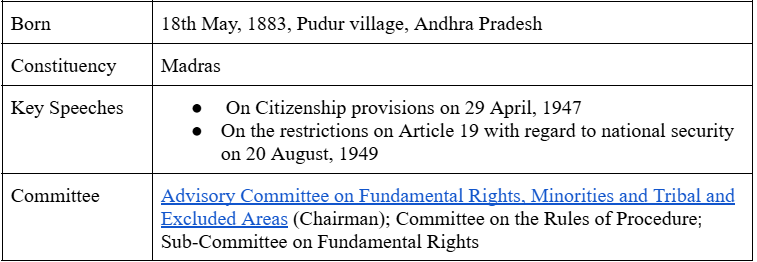
Alladi Krishnaswamy Ayyar was a brilliant lawyer. He was a competent student and later went on to become a tutor at his alma mater Madras Christian University. He rose to prominence in the bar and, at the age of 45, was named Advocate-General of Madras State from 1929 to 1944. In 1930, he was also appointed Dewan Bahadur. He was knighted in the New Year's Honours List in 1932. But he relinquished the Knighthood. He was a prominent jurist and was selected to the Government of India Committee to modify the legislation of Partnership and Sale of Goods 1929. Ayyar kept his library accessible to everyone and was very supportive of aspiring attorneys. He was awarded many accolades during his tenure as a lawyer, the kaiser-i-hind in 1926, the title of Dewan Bahadur in 1930, and 2 years later, he was knighted.
When he was elected to the Constituent Assembly, he was a full-time practicing lawyer. He was an important member of the Constituent Assembly and contributed to 9 committees. He was active in debates on a variety of issues.
He intervened in debates on Citizenship rights, including that of Naturalization of foreign individuals and was crucial in discussing the pros and cons of different choices and systems that the assembly was considering. He was also sceptical of the rights available to citizens under Article 19, keeping in mind the volatile and sensitive state of the country. He believed that the rights and freedoms given to the citizens should be regulated, subject to national security. He gives an example of Abraham Lincoln suspending the writ of Habeas Corpus to put his point across.
Using this example, he also comments on the power of the Emergency assigned to the President. Responding to Pandit Thakur Das, who believed that the powers under the Emergency are too broad and that the laws made in that duration would last long, he replied that the laws would lapse after the end of the State of Emergency. He cautioned that any attempt to further curtail the state’s power would be unnecessary and countered that members like Hriday Nath Kunzru who were anxious about the emergency powers, would be abused.
A firm believer in the Constitution, Alladi Krishnaswamy Ayyar thus played an extremely crucial role in the debates and discussions leading up to and in the process of the framing of the Constitution. He believed that the true test of the Constitution lay in its adoption and utilisation by the Indian citizens. His son established the Alladi Memorial Trust, which teaches Constitutional law, to honour his father’s Birth centenary.

Hansa Mehta
One of the most remarkable and influential members of the Constituent Assembly, Hansa Mehta, was extremely dedicated to human rights and women’s rights and was staunchly against reservations. While pursuing her higher education in London, she was taken under Sarojini Naidu's wing. Naidu, as Mehta wrote in her collection of essays, made her do things like public speaking, which she wouldn’t have dreamt of doing. She was one of the handful of women who received their bachelor's degrees. Her activism was hence set in motion. She visited the US soon after to learn more about American women’s education, a bold and uncommon move. Soon after she met Gandhi, who was jailed in the 1920s and in the 1930s, she joined his cause for women joining the freedom movement. She led protests, picketed stores selling English clothes and went to jail thrice. One of the founders and later the president of All India Women’s Conference, she combined the Indian freedom struggle with the struggle for women’s rights and drafted the Indian Women’s Charter of Rights and Duties.. Whilst advocating for improvement of women’s conditions of living, she was staunchly against the reservation of special seats for women. Mehta's win in the 1937 Bombay Legislative Council election served as her turning point in her political career. She entered the elections as a general category candidate after declining to run from a reserved seat. Up until 1949, Mehta continued to serve on the council.
Following her appointment to the Commission on the Status of Women in 1946, Mehta served until 1952. She was also named to the Commission on Human Rights in 1947, the year India attained independence. Mehta was also a member of the United Nations subcommittee on women's status and served concurrently in 1946. She and Eleanor Roosevelt served as the United Nations Universal Declaration of Human Rights Committee's vice-chairs. She was appointed to SNDT University in Bombay and became the first female vice-chancellor in India.
In 1946, she was elected to the Constituent Assembly, where she made ripples with her strong opinions and views on women’s rights and was regretful that the removal of the Purdah system couldn’t be brought under the ambit of fundamental rights. She advocated fiercely to bring about a Uniform Civil Code, which would supersede religious and personal laws and would bring about gender equality and play a crucial role in ‘building up one nation’.
She fervently supported the Objectives resolution by Nehru, which called for equality and justice for women. She also emphasised the need for having Directive principles to govern a multi-ethnic and diverse country like India.
Mehta represented India before the UN Human Rights Commission. She is credited with modifying the statement "All men are born free and equal" to "All human beings are born free and equal", ensuring that Article 1 of the Universal Declaration of Human Rights (UDHR) was made inclusive. Through Article 16 of the UDHR, Hansa Mehta and Eleanor Roosevelt guaranteed women's equality in marriage. She was awarded the prestigious Padma Bhushan in 1959.
Beyond her political acumen, Mehta was deeply curious, with interests in ornithology and astronomy. She reflected this in her children’s writing and Gujarati translations of European classics such as Gulliver’s Travels (Golibar ni Musafari) and The Adventures of Pinocchio (Bavla na Parakramo), as well as a metrical translation of the Ramayana from Sanskrit.
Hansa Mehta believed in the Indian civilisation’s belief in the power of women as Shakti. Hansa Mehta undeniably remains a strong persona, representing India on the global platform in the advocacy for women’s rights and would always be remembered as a fierce, vocal and highly admired historical figure.
.jpg)
Frank Anthony
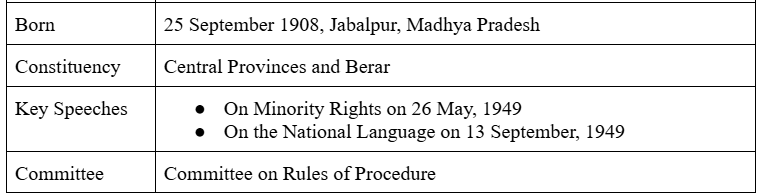
The leading voice of the Anglo-Indian Community, both inside and outside the Constituent Assembly, was Frank Anthony. An accomplished lawyer, he also went on to become an influential figure in the Anglo - Indian community, later becoming the head of the All India Anglo-Indian Association. He was also appointed Chairman of the Inter-State Board for Anglo-Indian Education. Anthony served as a member of the National Defence Council during the Second World War.
He was elected to the Assembly from the Central Provinces and Berar. He played a significant role in advocating for minority rights and participating in debates on the national language. He was against the antagonization of the English language and criticised those who favoured making ‘pure’ Hindi the national language. He shared instances to prove that pure Hindi was not the language preferred or used by the Indian layman. He proposed an amendment for the use of Hindi in the Roman script as the national language.
He also actively debated on the rights of minorities. He condemned the politicisation of language and regionalism. He discussed in detail the Advisory Committee on the Subject of Certain Political Safeguards for Minorities. He commended Patel's compassionate strategy for putting minority psychology ahead of strict logic and making sure that minority concerns were allayed in order to advance national unity. Anthony maintained that temporary protections for minorities were required throughout the shift to a genuinely secular and democratic India, stressing that the Committee's conclusions were based on consensus and compromise rather than imposition.
Anthony countered international allegations that Indian minorities were suppressed or subjected to oppression by emphasising that minority representatives like himself talked freely without fear or pressure. He admitted that although the Anglo-Indian community had traditionally been perceived as being distant from the fight for independence, the Advisory Committee's kindness demonstrated that the new India was prepared to put the past behind it and foster trust. He found the problems of contemporary communalism, especially language and provincial divisions, to be much more damaging than more traditional religious communalism. He emphasised that India's greatness relied on jettisoning limited revivalist notions and embracing the secular democratic ideal, with minorities playing a prominent role in the national journey. He encouraged both majority and minority populations to rise above sectarianism.
Anthony established the All India Anglo-Indian Educational Trust, which operates schools under his name. From 1950 to 1992, he was a nominated member of the Lok Sabha seven times. He authored ‘Britain’s betrayal in India - Story of the Anglo-Indian community’. Its goal was to document the Anglo-Indian community's history in India in a thorough manner. As Anthony himself pointed out, the book chronicled the cultural and social history of the Anglo-Indian community rather than serving as a "historical record."
Dakshayani Velayudhan

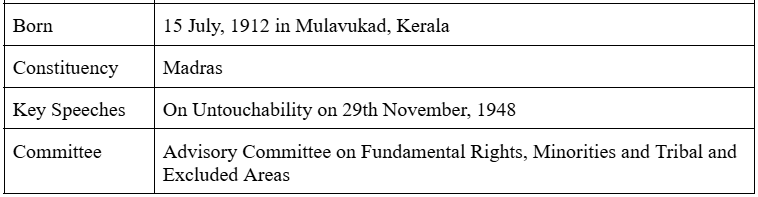
Dakshayani Velayudhan, one of the few women and the only dalit woman in the Constituent assembly played an indispensable role in the formation of the Constitution. Her roots lay in the Pulaya community, which was an oppressed and backward community. The Pulaya committee, banned from convening on land, gathered together on boats in a landmark moment in the 1913 Kayal Sammelanam on Kerala’s backwaters. This moment, which included Velayudhan’s family too, played a defining role in her life, so much that she requested her autobiography to be titled ‘The sea has no caste’.
Her decision to enter politics was greatly influenced by her family’s active participation in civil disobedience movements against the upper class orders. In the weekly publication of the All India Scheduled Castes Federation (AISCF), Jai Bheem, Velayudhan became a fervent critic of Congress politics. She also criticized the politics of B.R. Ambedkar and the AISCF at the same time, particularly their proposal for distinct electorates for the Scheduled Castes. This made her the target of sexist remarks and severe criticism and attempts to stop her from getting elected to the assembly, despite which she was elected as a member in 1946. Before that, she was also elected as a member of Cochin Legislative Council in 1945.
Being one of the youngest members at 34, Velayudhan became a powerful, independent voice that was not hesitant to disagree with the majority. During the Assembly’s discussions on Nehru's Objective Resolution, Velayudhan made her first intervention. She underlined that the Indian Constitution had a more significant duty than merely mediating the interaction between state and society, it had to completely transform society itself. She commented on communalism being the enemy of nationalism. Furthermore, she thought that implementing a set of "moral safeguards" was essential to the emancipation of Harijans.
Dakshayani presented a speech to the Assembly on November 29, 1948, regarding untouchability.She also challenged M. Nagappa and B.R. Ambedkar on an amendment that would have required a candidate for a reserved seat to receive a minimum percentage of votes from voters in the Scheduled Caste, claiming that this was equivalent to having separate electorates. Her 1st speech in the Assembly, regarding slavery and her later speech on untouchability went on to form the basis of Article 15 of the Constitution. She played a crucial role in debating and suggesting the redressal of untouchability via state propaganda.
She advocated strongly for the decentralization of power and pointed out the apprehension about states being dominated under the Centre’s powers. She denounced the "fascist social structure existing in India" and fervently backed the inclusion of a Fundamental Right against exploitation and forced labour.
Later on, Velayudhan and her husband became the 1st Dalit couple in the provincial parliament. Dakshayani Velayudhan will hold great symbolism and relevance for future generations, not just for her advocacy of equality and rights of the untouchable caste, but also for her pioneering social work in the field of women’s rights, for which she set up Mahila Jagriti Parishad in Delhi. Being a Dalit woman, an intersection of two extremely vulnerable identities, she defied restrictive norms and made her own path everywhere, truly an inspiration to women all across the country and the world. In 2019, the Kerala government introduced the Dakshayani Velayudhan Award to commemorate the long-lasting achievements of women who fight to empower others in the state.

Benegal Narsing Rau

Amongst the important names associated with the framing and drafting of the Constitution, BN Rau remains an extremely crucial figure. He is credited as the unsung architect of the Constitution. Nehru and Rau were contemporaries at Trinity College, and Nehru was all praises for Rau’s sharpness and far-sightedness and described him as a hard worker. A civil servant, he later served as the judge for the Calcutta High Court.
Apart from being a competent legal interpreter, Rau had several landmark judgments under his belt. All his achievements made him the ideal choice. He was appointed chairman of the committee on reform of Hindu law, apart from many other committees. His meritorious career led the Burmese leader to invite him to help draft Burma’s constitution.
BN Rau prepared a paper, ‘Outline of a New Constitution’, which was published in the Indian Constitution in the making (ed. by Shiva Rao), which he had prepared in the backdrop of the elections to provincial assemblies, which were being fiercely debated on by the INC and Muslim League. He attempted to provide a solution to the deadlock through a scheme. This paper had a significant impact on the Cabinet Mission proposals for the future of Constitutional India, post which he was appointed Constitutional Advisor to the Assembly. In accordance with the motion made by the Constituent Assembly on August 29, 1947, BN Rau was to develop a constitution as the first phase, taking into account the Assembly's previous decisions and discussions. By October 1947, Rau's Draft Constitution was complete. It was a lengthy document with thirteen schedules and 240 sections. It was handled singlehandedly by BN Rau. Perhaps he was the most significant contributor to the development of a strong atmosphere where citizens' rights and liberties are prioritised.
Rau took all necessary steps required to guarantee that every right listed in Chapter II could be enforced in court. For that, he is to be credited with including the section on ‘Right to Constitutional remedies’. Rau initially addressed the problem of defining the boundaries of rights, using Germany as an example to show how rights should not be structured. He demonstrated that fundamental rights were virtually useless if their boundaries were solely determined by the Legislature's definition of them by using Article 153 of the 1919 German Constitution, which dealt with property rights. He travelled around the world, meeting and consulting with Constitutionalists, attempting to find and curate the best possible model for the Indian Constitution with the aim of negating any models which could be harmful for the spirit of young Independent India.
An able civil servant, accomplished judge and competent draftsman, BN Rau’s role and efforts in shaping the Constitution of India thus resulted in a well-written, accommodative document. Rau played an integral part not just in forming the legal framework of the constitution but also in evaluating relevant and workable models to use to frame the Indian Constitution.

Begum Aizaz Rasul

In the midst of hundreds of voices representing various causes, ideologies and groups, a sole voice spoke for an entire section. Begum Aizaz Rasul stood as the only Muslim woman in the assembly. Before becoming a member of the Constituent Assembly, she was no stranger to politics, often accompanying her father to political conferences and also serving as his secretary. Begum Rasul was against and actively defied the purdah system.
She entered electoral politics after her marriage, when in 1936, elections to provincial assemblies and councils were announced after the Government of India Act, 1935. In 1937, she was elected as a Member of the Legislative Assembly from the United Provinces. She also served in a number of significant positions as an MLA, including Deputy President of the Council (1937–1940) and Leader of the Opposition (1950–1952). She advocated strongly against reservations for minorities in legislative assemblies, was against the partition of India and supported the abolition of the zamindari system.
Representing the United Provinces in the Constituent Assembly, she was actively participative in many debates on the issues of reservation, national language, whether India should remain a part of the Commonwealth, property rights, and rights of minorities. Begum Rasul advocated strongly against setting up separate electorates for minority communities, believing them to be meaningless, but also agreed with Dr Ambedkar, expecting the majority to be responsible and non-discriminatory towards the minorities.
She also rallied for the use of Hindustani as the national language, rather than ‘Sanskritized Hindi’, which very few people could understand and use. She also highlighted the importance of preservation of civil liberties of citizens by the Constitution and ensuring that the legislature can’t easily curb citizens’ fundamental rights.
She underlined the need for ‘just compensation’ with regard to the government’s power to acquire property. She also showed support to Nehru’s proposal for India to be a part of the Commonwealth whilst being a republic through a key speech on 17th May, 1949.
Begum Rasul carried her eminent political career forward and was elected as a member of the Rajya Sabha. Further, she remained elected as a member of the legislative assembly of Uttar Pradesh from 1969-89. Begum Rasul was passionate towards making Hockey popular and accessible to Indian women. She presided over the Indian Women's Hockey Federation for twenty years. She later headed the Asian Women's Hockey Federation.
Begum Rasul’s autobiography, ‘From Purdah to Parliament: A Muslim Woman in Indian Politics,’ gives important insights into the intersectionality in the functioning of politics in our country. Her contributions in the field of Social work were honoured with the Padma Bhushan in 2000. More than 75 years after her invaluable contributions in the proceedings of the Constituent Assembly, she still stands as a powerful, fearless, and resolute woman and leader. At a time when the majority of official governmental offices were practically implicitly reserved for men, her accomplishments were genuinely remarkable and admirable, with her being the first Indian woman to achieve them.