Constitution Of India
Part 15

Part XV sets out the constitutional framework for elections in India. It establishes the authority of the Election Commission and ensures the conduct of free and fair elections. Through these provisions, it safeguards the democratic process and the functioning of representative government.
The selected articles underline the institutional and procedural foundations of India’s electoral system.
Article 368
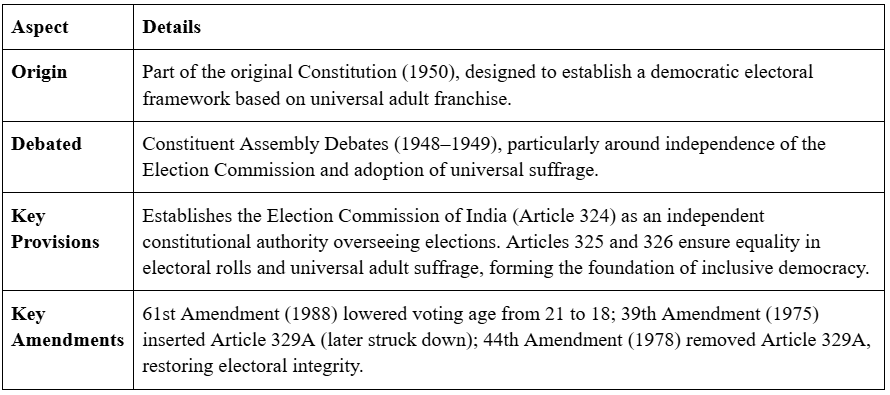
Part XV of the Indian Constitution (Articles 324 to 329) establishes the legal and institutional framework necessary for a functional democracy. It governs the conduct of elections to Parliament, State Legislatures, and the offices of the President and Vice-President. By establishing the Election Commission of India (ECI) as an independent constitutional authority, this Part ensures that the democratic process is shielded from executive interference. The framers envisioned these provisions as the bedrock of the Republic, moving away from the colonial legacy of restricted and communal electorates toward a system based on Universal Adult Franchise and a single general electoral roll.
ARTICLE 324: THE INDEPENDENCE OF THE ELECTION COMMISSION
Article 324 is the cornerstone of India’s electoral democracy, vesting the superintendence, direction, and control of elections in the Election Commission. During the Constituent Assembly debates, Dr. B.R. Ambedkar moved a significant amendment to centralize the electoral machinery. Originally, the draft suggested separate Election Commissions for each state, but Ambedkar argued that centralizing the apparatus was necessary to prevent local governments from discriminating against non-native citizens or minorities. Despite opposition from members like H.N. Kunzru, who feared that centralization might undermine federalism, the Assembly adopted the centralized model to ensure the ECI remained a neutral, autonomous authority.
The ECI's power is not merely administrative; it possesses residual powers to handle unforeseen situations during the electoral process. The judiciary has consistently upheld this autonomy. In the landmark case of Mohinder Singh Gill v. Chief Election Commissioner (1978), the Supreme Court ruled that the phrase "superintendence, direction, and control" is a broad concept that empowers the Commission to act where the law is silent, provided it does so to ensure a free and fair poll. Similarly, in A.C. Jose v. Sivan Pillai (1984), the Court clarified that while the Commission has plenary powers, it must still operate within the framework of laws enacted by Parliament.
ARTICLES 325 AND 326: EQUALITY AND ADULT SUFFRAGE
Article 325 and Article 326 represent the Constitution’s commitment to an inclusive democracy. Article 325 mandates a single general electoral roll for every territorial constituency, explicitly prohibiting discrimination based on religion, race, caste, or sex. This was a revolutionary departure from the British-era system of separate electorates, which the Drafting Committee viewed as a tool of communal division.
Article 326 established Universal Adult Suffrage, a principle that was initially met with skepticism by members like Brajeshwar Prasad, who argued that a largely illiterate population was not ready for such responsibility. However, the Assembly maintained that the right to vote was an essential instrument for the social and political empowerment of the masses. Originally, the voting age was set at 21, but it was later reduced to 18 years by the 61st Constitutional Amendment Act (1988) to encourage greater youth participation in the democratic process. The Supreme Court reinforced this in Kuldip Nayar v. Union of India (2006), noting that while the right to vote is a statutory right, it is foundational to the democratic structure of the Constitution.
LEGISLATIVE POWERS AND THE BAR ON JUDICIAL INTERFERENCE
Articles 327 and 328 delineate the powers of Parliament and State Legislatures to make laws regarding elections, such as the Representation of the People Acts of 1950 and 1951. However, Article 329 introduces a crucial limitation by barring the judiciary from interfering in electoral matters once the process has commenced. Article 329(a) prevents the questioning of laws related to the delimitation of constituencies or the allocation of seats, while Article 329(b) mandates that an election can only be challenged via an election petition.
In N.P. Ponnuswami v. Returning Officer (1952), the Supreme Court held that the term "election" encompasses the entire process from the initial notification to the final declaration of the result. The Court ruled that judicial intervention during the intermediate stages of an election would cause unnecessary delays and subvert the democratic timeline.
THE 42ND AND 44TH AMENDMENTS: THE BATTLE FOR BASIC STRUCTURE
The resilience of Part XV was most severely tested during the Emergency. The 39th Amendment Act had inserted Article 329A, which sought to place the election of the Prime Minister and the Speaker beyond the reach of the courts. This was a direct response to the ruling in Indira Nehru Gandhi v. Raj Narain (1975), where the Prime Minister's election had been set aside by the High Court. The Supreme Court subsequently struck down the offending parts of Article 329A, ruling that "free and fair elections" and the "rule of law" are part of the Basic Structure of the Constitution.
Following the Emergency, the 44th Constitutional Amendment Act (1978) omitted Article 329A, restoring the original integrity of the electoral provisions. These amendments and subsequent case laws have ensured that while the Election Commission enjoys broad discretionary powers, it remains accountable to the principles of constitutionalism, ensuring that the will of the people is accurately and fairly reflected in every vote.