Constitution Of India
Part 2

Part II of the Constitution of India deals with the question of citizenship at the commencement of the Constitution. Encompassing Articles 5 to 11, it lays down the conditions under which individuals were recognized as citizens of India in 1950, particularly addressing the complex circumstances created by Partition and migration between India and Pakistan. These provisions defined citizenship based on factors such as domicile, birth, descent, and migration. Part II also grants Parliament the authority to regulate citizenship by law, enabling future legislation—most notably the Citizenship Act, 1955—to determine how citizenship may be acquired, terminated, or otherwise regulated.
Article 5

Article 5 of the Constitution of India is an important article that lays out the mandatory provisions for Indian Citizenship. Designated as Article 5 also in the Draft Constitution of 1948, the article was debated in the Assembly from 10 August 1949 to 12 August 1949. Members of the assembly raised crucial questions on the definition of citizenship and moved amendments introducing special provisions for some religious communities and the inclusion of dual citizenship.
Initially, the provisions of the Article were that any person who or either of whose parents or grandparents was born in India and had not moved to any other country permanently after 01 April 1947 was eligible for Indian citizenship when the Constitution came into effect. Additionally, one can be an Indian citizen if a person, either of their parents or grandparents, was born as a citizen defined by the GOI Act 1935 in British India, Sri Lanka, Malaya, or Burma, and has a domicile in India without holding citizenship in any other country.
On 10th August 1949, President Rajendra Prasad started the debate after saying that “the article is a veritable jungle of amendments”. Dr Ambedkar moved some key amendments. Firstly, the eligibility was restricted to the parents, removing grandparents who are Indian as an eligibility criterion for citizenship. Secondly, an additional provision was added according to which a person who has been a resident of India for at least five years before the day of commencement of the Constitution, not holding any other citizenship, would be eligible for Indian Citizenship.
When the debate commenced, various amendments and interventions were made by different members of the Constituent Assembly. The first set of debates was centred around the definition of citizenship. Various members were not satisfied with the provisions defining citizenship. Some members compared the Draft Article with other nations and argued that these provisions would make Indian Citizenship the cheapest and easiest to acquire among the international community. A strong rebuttal came from other members of the assembly who argued that these provisions should not be compared with other countries that make tough laws for acquiring their citizenship, as they are bad examples.
Some of the members demanded adding residuary provisions which made any Hindu or Sikh, if not a citizen of any other country, entitled to Indian Citizenship irrespective of their residence in India. This demand reflected the anxiety emanating from the formation of Pakistan, completely on religious lines. However, this demand was criticised, arguing that ideals like justice and equity can’t be compromised. A demand for Dual citizenship was also voiced; however, the amendment was negatived.
As the assembly debated, some amendments were voluntarily withdrawn while others were negatived. Article 5 was passed on 12 August 1949. According to this article, any person who possesses domicile of India shall be a citizen if the person was born in India or either of whose parents was born in India, or had been an ordinary resident for five years before the commencement of the Constitution. No further amendments have been made to this article.
Article 6
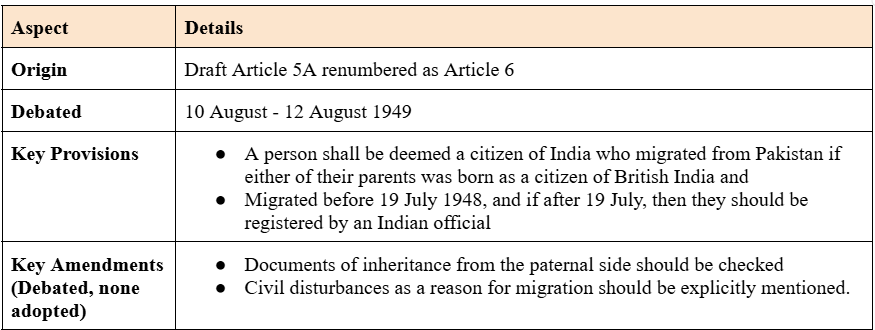
Article 5A, later renamed as Article 6, deals with the rights of those persons who have migrated from Pakistan to India. The article was debated on the Assembly floor on 10, 11 and 12 August 1948 and isn’t part of the Draft Constitution. The article is of immense importance because of its direct relation with the aftermath of partition, and the debates around it provide us a glimpse into the minds of the Constitution makers in a tumultuous time.
According to Article 5A, any person who doesn’t find themself eligible through Article 5 shall be deemed an Indian citizen if either of their parents or grandparents was an Indian Citizen as defined in the GoI Act 1935, born in Indian territory and has migrated before 19 July 1948, residing here to become a permanent resident. The very next clause stated that if the person had been migrated after 19 July 1948, they need to get registered by an Indian officer through an application made by them. However, to register themself as a citizen of India, they need to be a resident for a minimum of 6 months.
A group of members in the assembly argued to add the phrase ‘on account of Civil disturbance or the fear of such disturbances’ to make it explicitly clear that the article is introduced in the wake of mass migration from Pakistan to India caused by partition violence. K. T. Shah, a member from Gujarat, said that citizenship should not be a commonplace affair, but rather a matter of pride and privilege. And therefore, to keep a tight check on granting citizenship to migrants coming from Pakistan, documents of their inheritance from their paternity should be looked at. According to Shah, whereas maternity is a fact, paternity is an assumption.
While the article was heavily debated with lots of amendments getting discussed, none of them made it to the final draft of the constitution. While some of the amendments that were destined to be put on the floor were withdrawn, the majority of them did not pass and were rejected. Thus, Article 5A, as proposed by Dr Ambedkar, remained as it was, facilitating the migration of people who had left their homes in the search for a new home in a new country.
Article 7
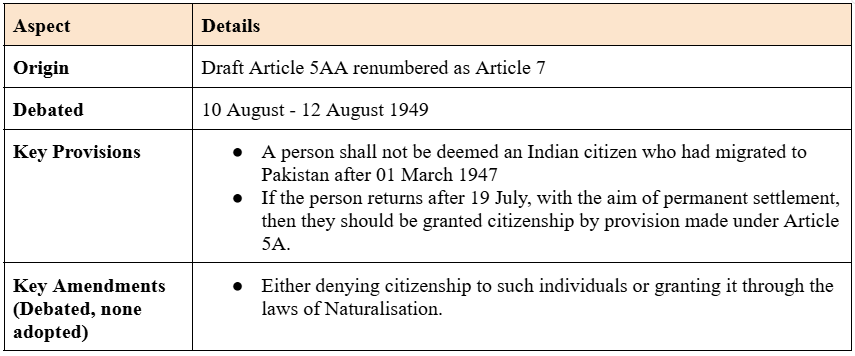
Draft Article 5AA, debated on 10,11 and 12 August 1948, deals with the question of citizenship of any person who has migrated to Pakistan and wishes to return to India. Later renumbered as Article 7, the debate around this article was centred around the loyalty of such individuals, who went to Pakistan to be permanent residents there. Concerns were also voiced on the permit system and the property of those who have left India.
According to the Draft Article proposed by Dr Ambedkar, any person who has migrated from India to Pakistan after 01 March 1947 shall not be deemed an Indian Citizen. However, according to the second clause, if a person returns to India with a valid permit for permanent residence and resettlement, such individuals should be deemed as citizens under 5A(Article 6) returning after 19 July 1948.
Some of the members vehemently opposed the article, arguing that those who had voluntarily left also transferred their loyalty. Granting citizenship with such ease to these persons would be a betrayal of those who never left India. One of the members argued that citizenship for such individuals should be denied, as they themselves forfeited their right to be an Indian citizen. Permit System, argued some members, makes it easy for these migrants to obtain Indian citizenship. Dr Ambedkar, on 12 August, addressed these concerns. He argued that the Indian government had promised rehabilitation and resettlement to such people who had left their homes and hearths in Pakistan to build a new one in India and live here. The article, according to him, should be accepted as it was.
Bhopinder Singh Man, a member, raised the issue of “evacuee property”, the property left behind by those who had shifted to Pakistan. Another member reiterated that there is no relation between property rights and the question of citizenship. Draft Article 5AA, which became Article 7 on the promulgation of the Constitution in 1950, was adopted without any amendment. No direct amendments have been moved to the Article after the commencement of the Constitution. Its scope is subject to the Citizenship Acts made by the Executive periodically.
Article 8
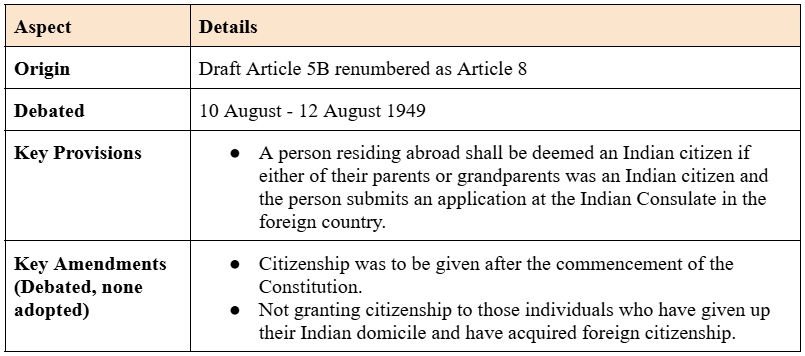
Article 8 of the Constitution, which was previously debated as Article 5B, specifically addresses the rights of an Indian person residing outside India. The article was not part of the initial Draft Constitution and was later moved through an amendment by Dr Ambedkar, Chairman of the Drafting Committee. According to the article, a person residing outside India is fit to be an Indian Citizen if either of their parents or grandparents was born in India and was a citizen as defined by the GoI Act 1935. To be a citizen, a person should make an application and register themselves at the Indian Consulate present in the country where they reside, irrespective of the day of commencement of the Constitution.
The Draft Article 5B was not widely debated. Some amendments were moved, mostly related to the substitution of words like “a person” to “any person” or “made by parliament” to “on behalf of the Parliament”. A significant intervention came from Jaspat Roy Kapoor. He argued that the Draft Article 5B gives an advantage to the Indians residing abroad, as the limitation of the day of commencement of the Constitution is absent in this article. Furthermore, any resident of Pakistan who is excluded under the provisions made by the preceding articles can apply for Indian citizenship by relocating to a different country.
Another member moved an amendment to grant citizenship to such individuals only after the commencement of the constitution. A new proviso was argued, which denied to those individuals who had migrated to Pakistan after 01 April 1947 or acquired citizenship of any other nation. The article was adopted as it was on 12 August 1948 without any amendments. In the final Draft of the Constitution of India, it is named as Article 8.
No direct amendments have been moved to the Article. Its scope is subject to the Citizenship Acts made by the Executive periodically.
Article 9
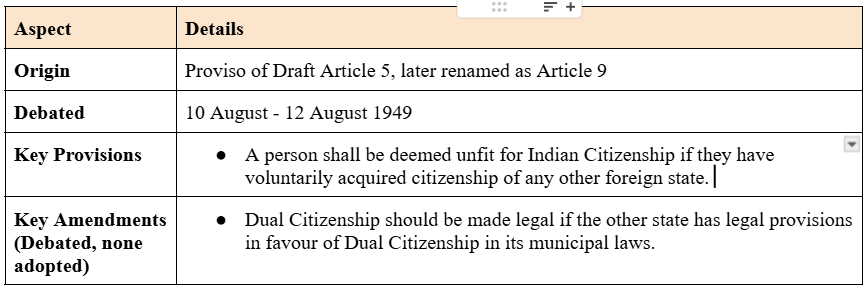
Article 9 of the Indian Constitution traces itself to a proviso in Article 5 of the Draft Constitution. The article is of immense significance due to its nature of barring Dual Citizenship. During the debates on Article 5, the Drafting Committee revised its stand and made it a standalone Article dealing with the issue of Dual Citizenship.
According to the article, any such person who voluntarily carries citizenship of any foreign country should be deemed unfit for Indian citizenship. An intervention came from K. T. Shah, who supported dual citizenship and argued that India should legalise Dual Citizenship on the grounds of reciprocity. According to him, the Indian Citizenship of any person should not be cancelled out if the municipal laws of the other country permit an individual to have two citizenships. The proposed amendment, however, was negatived. The article was not debated very much and was readily accepted as Article 9 of the Indian Constitution.
No direct amendment has been made to the Article. All the changes in its scope and nature are defined by the amendments made to the Citizenship Act. The Citizenship (Amendment) Act, 2003, introduced a new category named Overseas Citizen of India (OCI), which provides a few rights, like a lifelong visa and work permits, to people of Indian origin living outside India.
Article 10

Article 10 of the Constitution, debated as Article 5C, was not a part of the Draft Constitution. It was proposed on 10 August 1948 by the Chairman of the Drafting Committee. According to the proposed article, any person who is a declared citizen of India by the provisions made in Articles 5-9 shall remain a citizen of India. However, their citizenship is subject to the laws made by the Parliament. The article was not discussed substantially and was adopted without any significant amendments.
Article 10 is of importance because it clarifies that the Citizenship of India is not an absolute right but can be changed. The power to change the provisions concerning citizenship made by the Constituent Assembly rests with the Parliament. No significant debate took place regarding this article. However, Mahboob Ali Baig moved an amendment to delete this article as he found it an unnecessary clarification. He argued that this obvious fact is already clear through the provisions of Article 6 of the Draft Constitution (Article 11 of the Constitution). Dr Ambedkar replied that the status of Citizenship being granted through this assembly is temporary and should be clearly clarified to avoid any confusion. Article 5C was renumbered as Article 10 and was adopted without any amendment.
No amendments have been made directly to this Article. The interpretation and scope changes according to the Amendments made to the Citizenship Act.
Article 11
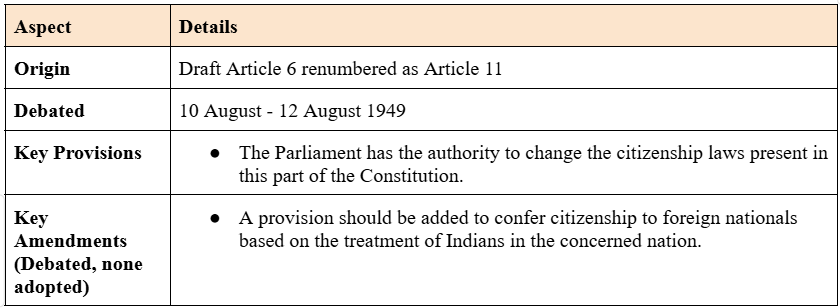
Article 6, renumbered as 11, of the Draft Constitution is a major article which bestows the power of termination as well as acquisition of citizenship in the Parliament. This article was debated from 10 to 12 August 1949. This article was not widely debated, with only one significant amendment being moved by a member.
Dr Ambedkar, in his proposal, argued that these laws are just to facilitate citizenship till the commencement of the constitution. To create permanent laws for citizenship should be the work of the ‘future parliament’. The future parliament holds the authority to change the citizenship laws made before or after the commencement of the constitution. This article provides the flexibility to the Parliament so that it can work and make changes accordingly, understanding the need of the hour.
K. T. Shah, while speaking on Dual Citizenship, argued for making amendments to Draft Article 6. A positive prohibition, according to Shah, ought to be there on the powers of the Parliament, which would provide citizenship on a reciprocal basis. He demanded that equal citizenship should not be conferred on individuals of those nations where Indians are not treated equally. This should be made a mandatory and permanent duty of the Parliament, which would be subject to no changes. Dr Ambedkar, though, reiterated the fact that such provisions should be made by the Parliament whenever the need arises. Draft Article 6, renamed as Article 10 in the Constitution, was adopted as it is on 12 August 1949.
While no amendments were made to this article after the Proclamation of the Constitution, it is invoked to make amendments in the Citizenship Act, as well as in some crucial judicial cases. While Article 11 empowers the Parliament to make laws regarding the adoption or termination of citizenship, other related facets have been discussed in some crucial judgments. In Ebrahim Vazir Mavat v. State of Bombay (1954), the court held that while Parliament is the sole authority for making citizenship laws, these laws themselves should be fair and reasonable and abide by the fundamental rights. The petitioner in this case had visited Pakistan and returned to India. However, he was deported on the grounds of the Influx from Pakistan (Control) Act, 1949, whose Section 7 provided arbitrary power to the executive to deport a person if they lacked a permit. The petitioner challenged this, arguing that Section 7 is unconstitutional and hinders the Fundamental Right of freedom to reside and settle in any part of the Country. The Court, providing its interpretation of Article 11, held that the executive can make provisions regarding citizenship but cannot physically deport anyone. Rather, in case of a lack of permits, fines can be imposed.
Article 370
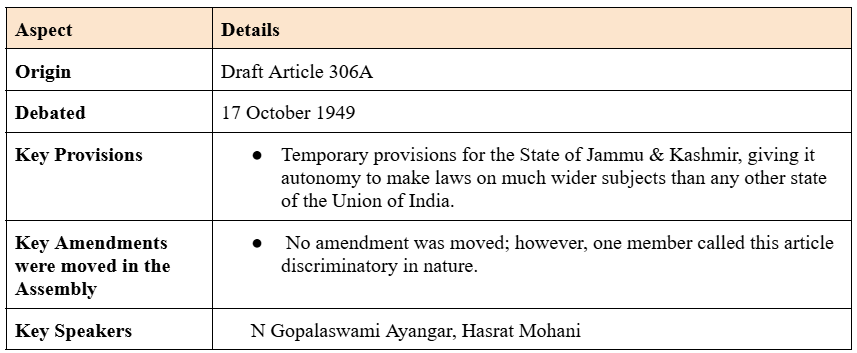
Article 370 of the Constitution is among the most controversial and disputed articles in the history of post-Independent India. It was debated as 306A on 17 October 1949. N Gopalaswami Ayanagar, a member of the Drafting Committee, proposed this article, followed by an intense discussion. The article was later renamed as Article 370 and was part of the Indian Constitution till its abrogation in 2019.
Article 370 deals with the state of Jammu and Kashmir. On account of political conditions in the state of Jammu and Kashmir, some temporary provisions were granted to the state, which provides it with much more autonomy than the other states. Article 370 heavily draws its provisions from the Instrument of Accession (IOA) of Jammu & Kashmir, signed by Maharaja Hari Singh. Draft Article 306A clarifies that the Constitution of India would be applicable in the State of Jammu & Kashmir, according to the terms and conditions laid out in the IOA.
According to the Article, provisions made for princely states would not apply to the state of J&K. The Indian Parliament could make laws only on the subjects in the Union and Concurrent list, if those specific subjects are mentioned in the Instrument of Accession, namely Defence, External Affairs, Communication and some Ancillary Affairs. Additionally, consultation with the state government should be done before the official declaration of such laws by the President of India. On the subjects other than those mentioned in the IOA, the President has to seek the full agreement of the state government to make laws on such subjects. This clause of Article 370 vested complete power in the Constituent Assembly of Jammu & Kashmir to reject or accept laws proposed by the Indian Parliament, providing it greater autonomy than any other state.
The third clause of the Article carries special significance because it clearly states that the President could make modifications, exceptions, or abrogate the Article on the suggestion of the Constituent Assembly of the State. After the article was proposed, Hasrat Mohani stood arguing that this article is discriminatory in nature. According to Mohani, while the princely state of Jammu & Kashmir is getting a greater degree of autonomy and special provisions, the early princely states, like that of Baroda, got nothing for becoming a part of India. However, Ayangar replied that it is due to the political condition of the state that these temporary provisions are being granted. The article was adopted by the Assembly on the same day without any significant amendments.
Nevertheless, after the commencement of the Constitution, Article 370 remained a point of heated exchange between political actors as well as citizens of this nation. Various presidential orders in the span of 6 decades provided special provisions and strengthened the autonomy of the state. Interestingly, those who supported the article and those who were opposed to it argued on the same lines that J&K is a powder keg for India. While the former supported the concessions due to the sensitive nature of the state there, the latter argued for its abrogation and complete control in the hands of the Union Government for better administration. The article was abrogated through presidential order - CO 272 and CO 273 in August 2019. The first presidential order changed ‘Constituent Assembly’ to ‘Legislative Assembly’. Though the abrogation recommendation of the state government was necessary. Due to the President’s Rule in the state of Jammu & Kashmir, all power was with the Parliament. On 6 August 2019, the Presidential Order CO 273 was released, which abrogated Article 370 on the recommendation of both Houses of Parliament.