Constitution Of India
Part 4A

Part IVA introduces the Fundamental Duties, outlining the responsibilities expected of citizens in sustaining the nation’s values and institutions. These duties emphasize civic consciousness, respect for the Constitution, and a commitment to harmony, environment, and public life. Together, they balance the rights guaranteed elsewhere in the Constitution.
Article 51A
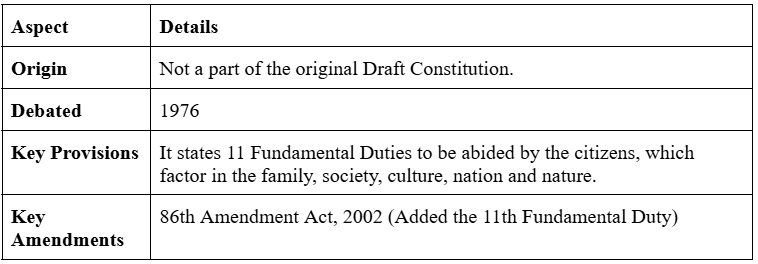
Article 51A was not a part of the Constitution of India 1950. Initially, the Indian Constitution made no mention of citizens' duties. It was inserted by the 42nd Constitution Act, 1976, on the recommendation of the Swaran Singh Committee. It was subsequently amended by the 86th Constitution Act, 2002. The Article comprises 11 Fundamental Duties. The 42nd Amendment Act added 10 duties, and the 11th was added later on by the 86th Constitutional Amendment Act.
The concept of Fundamental Duties was drawn from the Constitution of the (erstwhile) Soviet Union (present-day Russia). The thought that went behind the addition of Fundamental Duties in the Constitution was that citizens need to remember that they have obligations to their country and community while exercising their rights. People have been seen to care more about their own rights than the rights of their fellow citizens, failing to remember that carrying out their responsibilities also safeguards those rights.
The Article states the citizens’ duties to promote harmony and to inculcate a sense of responsibility in the citizens. It mentions that every citizen of India has a duty to uphold the Constitution, respect its ideals, and honour the National Flag and Anthem. Citizens must cherish the noble ideals of the freedom struggle, protect the sovereignty, unity, and integrity of the nation, and be prepared to defend the country when required. They are expected to promote harmony, foster brotherhood beyond religious, linguistic, and regional divides, and reject practices that degrade women. It is also their duty to preserve India’s rich cultural heritage, protect and improve the natural environment, and show compassion toward all living beings. Citizens should cultivate a scientific temper, humanism, and a spirit of inquiry and reform, safeguard public property, and avoid violence. Finally, they must strive for excellence in all individual and collective endeavours. The 11th duty added in 2002 stated that parents or guardians are obligated to provide educational opportunities to children between six and fourteen years of age.
Fundamental Duties under Article 51A are non-justiciable and were intended to guide civic behaviour through moral responsibility rather than legal compulsion. Courts have treated these duties as interpretive aids to support legislation and public policy, particularly in areas like environmental protection, but not as grounds to limit Fundamental Rights. While citizens’ duties are aspirational, the State’s obligations under the Directive Principles are binding in spirit, reflecting the idea that power entails greater responsibility. Importantly, constitutional duties may also include dissent and the protection of democratic values, and an excessive focus on duties risks enabling majoritarian norms to undermine pluralism and rights.
The Supreme Court has referenced Fundamental Duties under Article 51A in several judgments, even though they are not directly enforceable by writ. In M.C. Mehta v. Union of India (1988), the Court linked Article 51A(g) with environmental protection and directed the government to promote education and initiatives for improving the environment in schools. In AIIMS Students’ Union v. AIIMS (2001), the Court noted that while Fundamental Duties are morally obligatory, they provide valuable guidance in constitutional interpretation, and observed that duties of citizens collectively reflect the state’s responsibility. It was found that fundamental rights and duties are equally significant. Fundamental duties cannot be disregarded as obligations in Part IV A of the COI, even though they are not enforceable like basic rights.
In Aruna Roy v. Union of India (2002), the Court recognised that educational and social initiatives, such as value education promoting harmony and brotherhood under Article 51A(e), align with constitutional values. The Supreme Court ruled in Shri Rangnath Mishra v. Union of India (2003) that social as well as legal implications should be used to enforce fundamental duties.
Article 51A, while non-enforceable by law, proves to be a significant addition to the Indian Constitution, as it serves as a reminder to the citizens that, along with enjoying rights, citizens should also remember their duties to maintain balance in and to give back to the society as well as the country.